
William Dampier
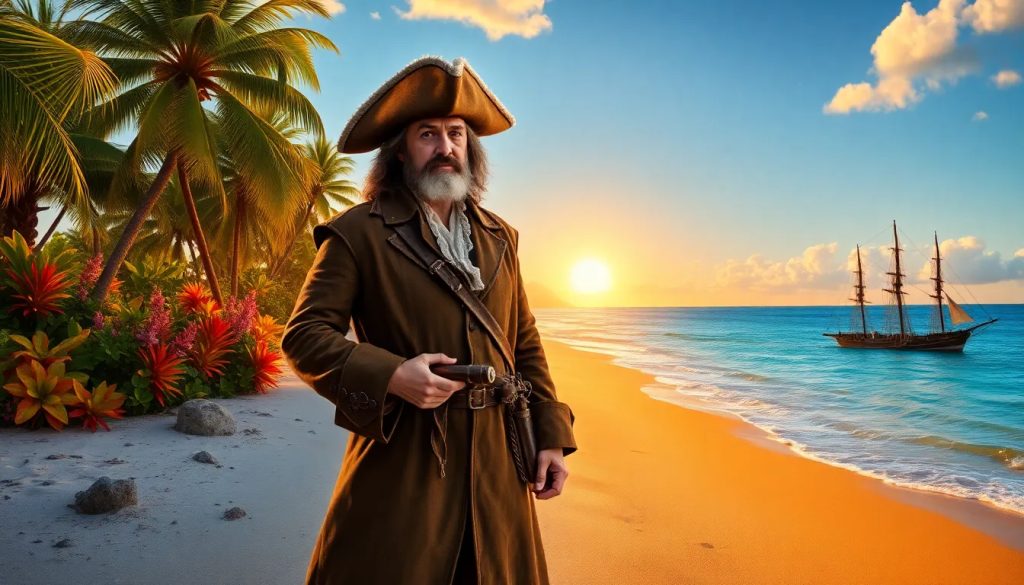
The name William Dampier conjures images of swashbuckling pirates and uncharted territories. Yet, beyond the lure of treasure and fame, Dampier harbored a relentless curiosity about the natural world. His legacy endures not only in the annals of piracy but also in the field of scientific exploration, where his keen observations laid groundwork for future naturalists like Darwin.
How Did William Dampier Influence Natural History?
As a naturalist, Dampier's contributions to natural history were unprecedented for his time. His meticulous records of plant and animal species encountered on his voyages expanded the European understanding of biodiversity.
His eye for detail extended beyond the biological, documenting meteorological and oceanographic phenomena which aided future scientific study.
Through his writings, Dampier shared with the world a plethora of new species and natural phenomena, fostering a growing interest in the natural sciences that would blossom into the Enlightenment.
What Is William Dampier Famous For?
Dampier is renowned for his dual life as a buccaneer and explorer. His adventurous spirit and insatiable curiosity were the driving forces behind his extensive travels.
He is celebrated for his richly detailed journals, which provided insights into lands and cultures that had been hitherto unknown to Europeans.
His work, A New Voyage Round the World, is a seminal piece that vividly portrays the life of a gentleman of fortune and an inquisitive mind at sea.
What Did William Dampier Discover?
Dampier's voyages led to the discovery of several species of plants and animals, introducing them to the European scientific community.
He also made crucial geographical discoveries, being the first to map parts of Australia and New Guinea's coastlines.
In the realm of navigation, Dampier's observations greatly improved the accuracy of maritime maps and charts, which were invaluable for future explorations.
How Did William Dampier Die?
The end of William Dampier's life is shrouded in as much mystery as some of his explorations. Records indicate that he died in London in March 1715, but the exact cause of his death remains unknown.
However, his death marked the end of an era as one of the last great figures of the Golden Age of Piracy and a forerunner in the field of scientific exploration passed away.
William Dampier's Impact on Australian Exploration
Dampier's exploration of Australia's northwest coast in 1688 and later in 1699, marked the first recorded landfall on the continent by an Englishman.
His notes on the Aboriginal people, fauna, and flora of Australia were some of the earliest and most detailed, providing a valuable record for future explorers.
Furthermore, his cartographic work contributed to the world's geographical knowledge and paved the way for future expeditions to the Australian continent.
William Dampier: A Unique Blend of Piracy and Science
Dampier's life was an extraordinary blend of piracy and science, a combination that was rarely seen during the Age of Exploration.
His ability to navigate the high seas with the eye of a buccaneer and the mind of a scientist made him uniquely suited to advancing European knowledge about the distant corners of the world.
His legacy lies not just in his adventures, but in the extensive body of knowledge he contributed to natural history and scientific exploration.
- Historical period: Golden Age of Piracy
- Field or role: Explorer, Pirate, Naturalist
- Main themes: Biodiversity, Maritime Navigation, Indigenous Cultures
- Resonance of words: Enlightening accounts of uncharted territories
In the quotes below, we find reflections of William Dampier's worldview, where the pursuit of knowledge is as thrilling as the chase for fortune. His words, though centuries old, continue to inspire those who seek to understand our world's vast complexities.
- Reflection: Considering the natural world's interconnectedness
- Leadership: Navigating uncharted territories with courage and insight
- Creativity: Drawing inspiration from the diversity of life
- Resilience: Persevering through the challenges of exploration
- Personal Growth: Embracing the unknown as a catalyst for self-discovery
Related authors often compared to Dampier include:
- James Cook: Like Dampier, Cook combined exploration with scientific discovery, creating detailed maps and documenting new species.
- Charles Darwin: Darwin's theory of evolution was influenced by explorers like Dampier, who first documented the rich biodiversity of remote lands.
- Alexander von Humboldt: Humboldt's systematic approach to studying the interconnectedness of nature echoes Dampier's detailed observations.
William Dampier's legacy as a pirate-naturalist stands as a testament to the boundless potential of human curiosity and the enduring quest for understanding the natural world.