
William Mulholland
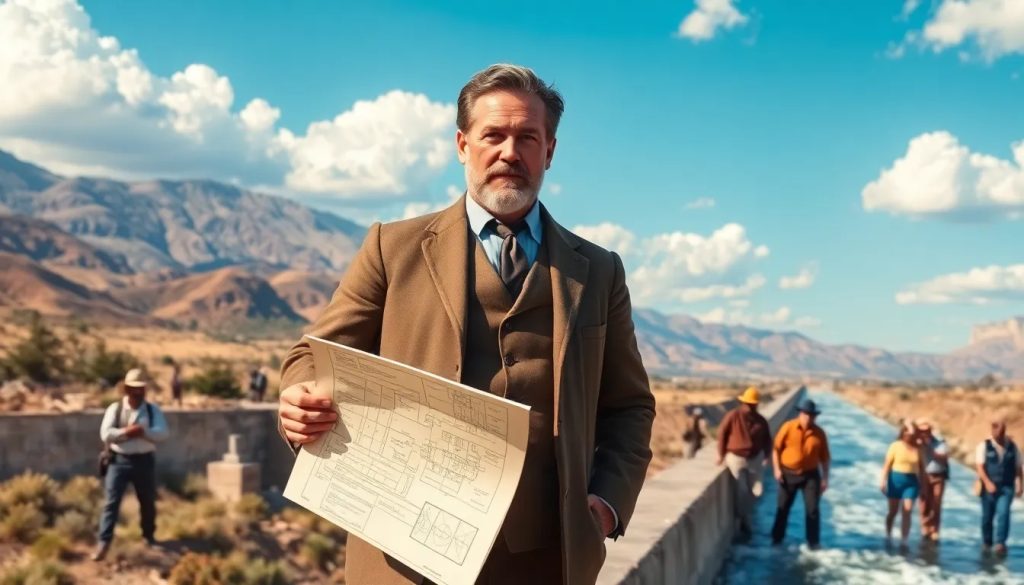
William Mulholland stands as a testament to the transformative power of vision and engineering. His story is not just about the construction of a monumental aqueduct but a narrative of how a single individual's efforts can reshape the future of an entire city. From his humble beginnings to his role as the architect of Los Angeles' water system, Mulholland's life is a tale of ambition, controversy, and the complex relationship between nature and urban development.
- What was William Mulholland's role in Los Angeles' water history?
- How did William Mulholland overcome challenges during aqueduct construction?
- What is the significance of the Owens River aqueduct designed by William Mulholland?
- What are the key events in William Mulholland's life?
- How did William Mulholland contribute to the growth of Los Angeles?
- What are the main themes explored in Les Standiford's book about William Mulholland?
- Practical ways to use William Mulholland's legacy
- Related authors and figures
What was William Mulholland's role in Los Angeles' water history?
As the chief engineer of the Los Angeles Department of Water and Power, William Mulholland was the driving force behind the design and construction of the Owens River Aqueduct. This massive engineering feat, completed in 1913, was crucial in transporting water over 200 miles from the Owens Valley to the burgeoning city of Los Angeles.
His work provided the much-needed water resources that allowed Los Angeles to expand beyond the constraints of its geographical location. Mulholland's foresight and determination were instrumental in turning what was once a semi-arid region into a thriving metropolis.
The narrative of Mulholland's life reflects the American dream for many Irish immigrants like himself, who sought opportunity and made significant contributions to their adopted homeland's development.
How did William Mulholland overcome challenges during aqueduct construction?
Mulholland faced numerous obstacles while realizing his vision for the aqueduct. From natural barriers such as the rugged terrain of the Sierra Nevada to political opposition from residents of the Owens Valley, the challenges were immense.
Employing innovative engineering solutions, Mulholland and his team built tunnels, siphons, and canals through some of the most challenging landscapes. Their work involved not only technical expertise but also sheer physical endurance and resourceful problem-solving.
Additionally, he had to navigate complex political waters, securing funding and public support for the project, which at times seemed an insurmountable task given the scale and cost implications.
What is the significance of the Owens River aqueduct designed by William Mulholland?
The Owens River Aqueduct was not only a remarkable engineering achievement of its time but also a pivotal development in the history of Los Angeles and water management in the arid West. It ensured a reliable water supply essential for the city's growth and helped set a precedent for other large-scale water projects across the United States.
However, the aqueduct's construction had lasting environmental impacts on the Owens Valley, raising questions about water rights and the ethics of water diversion—issues that remain relevant in discussions of modern water management and sustainability.
Despite the controversy, the aqueduct serves as a testament to Mulholland's impact on Los Angeles, demonstrating how infrastructure can profoundly influence urban growth and regional development.
What are the key events in William Mulholland's life?
- Born in Belfast, Ireland, in 1855, Mulholland immigrated to the United States as a young man and found work as a ditch tender.
- He rose through the ranks to become the head of the Los Angeles Water Company, later the Los Angeles Department of Water and Power.
- The construction of the Owens River Aqueduct was his crowning achievement, but it was also followed by the tragic St. Francis Dam disaster in 1928, which tarnished his reputation.
- Mulholland retired shortly after the disaster, yet his contributions to water management and urban planning continue to be studied and recognized.
How did William Mulholland contribute to the growth of Los Angeles?
The water sourced from the Owens River was a catalyst for transformation in Los Angeles, enabling the city to support a rapidly growing population and a diversifying economy. Without Mulholland's vision and technical expertise, Los Angeles might not have become the global metropolis it is today.
His work facilitated not just urban expansion but also agricultural development in the San Fernando Valley, leading to economic prosperity and establishing Los Angeles as a key center for trade, entertainment, and culture.
Mulholland's engineering innovations paved the way for future projects and technologies that continue to shape water infrastructure and urban growth, reflecting his enduring legacy in the field.
What are the main themes explored in Les Standiford's book about William Mulholland?
Les Standiford's book delves into themes such as the American dream, the impact of technological progress on society, and the moral dilemmas posed by manipulating the natural environment for human benefit. It explores Mulholland's rise from obscurity to prominence and the complexity of his legacy.
The narrative captures the spirit of an era marked by rapid industrialization and growth, highlighting Mulholland's role in shaping the urban landscape and the cultural ethos of California and the West.
Practical ways to use William Mulholland's legacy
- Inspiration for leadership: Mulholland's tenacity and vision can serve as a model for aspiring leaders in various fields.
- Case studies in engineering and urban planning curricula: His work offers valuable lessons on the importance of sustainable development and the consequences of altering natural landscapes.
- Reflection on water ethics: Discussions around Mulholland's projects can prompt conversations about contemporary water management practices and the rights of communities.
- Personal growth: Mulholland's life story encourages individuals to overcome obstacles and pursue big goals.
Fred Eaton: As the former Mayor of Los Angeles, Eaton was a key figure in the development of the city's water infrastructure and worked closely with Mulholland on the aqueduct project.
Robert Moses: Known for his work in New York, Moses shares similarities with Mulholland regarding the scale of urban projects and their lasting impacts on cities.
John Wesley Powell: A pioneer in American exploration and water policy, Powell's contributions to understanding water in the West resonate with the issues Mulholland faced.
William Mulholland's story is a powerful piece of California history and civil engineering lore. His ability to visualize a future for Los Angeles and his willingness to confront the numerous challenges that stood in his way are as relevant today as they were a century ago. His legacy in water management and urban development continues to provoke discussion and debate, ensuring that his impact on Los Angeles and water infrastructure will not be forgotten.