
William Osler
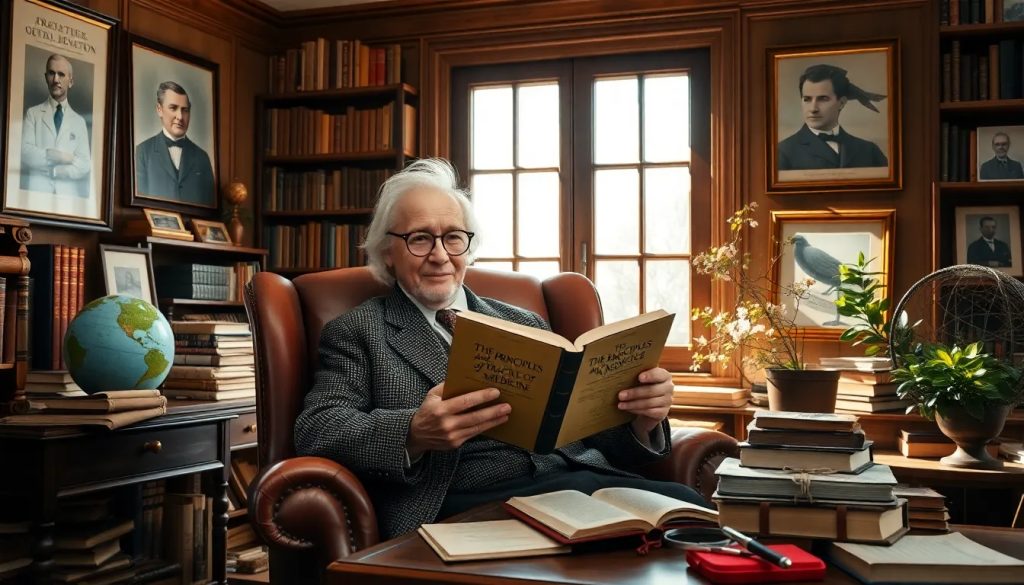
William Osler: The Father of Modern Medicine
The enduring interest in William Osler's words and insights bears testament to his profound impact on medicine and medical education. His legacy is not merely of historical significance but continues to inform and inspire current practices in healthcare. Osler's holistic and empathetic approach to treatment, along with his pioneering work in reshaping medical training, earmarks him as an essential figure whose quotes reflect a deep understanding of the human condition, in and out of the clinical setting.
At a glance
- Historical period: Late 19th to early 20th century
- Field: Internal medicine and medical education
- Main themes: Humanistic approach to medicine, empirical learning, physician-patient relationship
- Resonance: Osler's words encapsulate a timeless wisdom that bridges the art and science of medicine
Core ideas in Osler's quotations
William Osler's quotations mirror the essence of his medical philosophy—a blend of scientific rigor, compassionate care, and lifelong learning. He championed the idea of the clinic as a classroom, evolution in medical education, and a patient-centric approach to care. Osler’s teachings and quotes often revolve around the following themes:
- The importance of clinical experience and observation in medical training.
- Adopting a compassionate and empathetic approach to patient care.
- Continuous self-improvement and education as a cornerstone of professional life.
- The value of balancing scientific knowledge with a humanistic understanding of patients.
- Maintaining humility and curiosity throughout a medical career.
- The significance of mentorship and role models in shaping young physicians.
- Embracing the unpredictability and challenges of medical practice.
Interpreting Osler's most representative quotes
Delving into Osler's best-known quotes, we find a rich tapestry of insight that transcends time. Each quote serves as a beacon, guiding not just medical professionals but also those who seek wisdom in their daily lives. Below, we explore the thematic resonance of these quotes, rather than dissecting them line by line:
For example, Osler's views on the importance of lifelong learning and the dangers of complacency in medicine echo in his advice to students and practitioners alike. He believed in the power of example—not just the acquisition of knowledge but the application of it in the service of others.
Practical applications of Osler's quotes
- Reflection: Contemplating the deeper meanings behind Osler's words can lead to personal and professional growth.
- Journaling: Writing about how these quotes relate to one’s own experiences can be a powerful exercise in self-discovery and empathy.
- Leadership: Osler’s quotes provide valuable lessons in mentorship and the responsibilities of guiding others.
- Creativity: They encourage looking beyond conventional wisdom to find innovative solutions.
- Resilience: His advice often speaks to the strength needed to face challenges in both medicine and life.
- Personal growth: Embracing Osler's teachings can inspire a balanced and reflective approach to life’s endeavors.
Sir William Osler stands among giants in the medical field, and his influence can be seen in the works of several contemporaries and successors. Here are a few authors whose writings resonate with Osler's teachings:
Harvey Cushing: Known for his work in neurosurgery, Cushing’s emphasis on meticulous observation mirrors Oslerian principles.
Abraham Flexner: His critique of medical education led to reforms that aligned with Osler’s vision of clinical learning.
Rudolf Virchow: A pathologist like Osler, Virchow’s connection to social medicine complements Osler’s humanistic approach to patient care.
Hippocrates: Often referred to as the "Father of Medicine," his teachings on the art of medicine share a kinship with Osler’s ethos.
Reflecting on William Osler, one cannot help but be struck by the breadth of his contributions—from his writings, which continue to educate, to his influence on the structure of medical training, and his humane approach to patient care. Osler's enduring legacy in internal medicine and his philosophy of practice remain cornerstones of modern medical education, fostering a universal appreciation for the dedication and compassion that define the best of healthcare. His principles continue to underpin the ethos of institutions such as Johns Hopkins University, McGill University, University of Pennsylvania, and Oxford University, where the spirit of Oslerian medicine lives on.
Osler’s impact is not confined to the historical development of medical education but extends to the very ethos with which physicians approach their practice. He remains a central figure in medical history, not only for his contributions to medicine but also for his ability to articulate a vision of healthcare that is both scientifically sound and richly compassionate. In this way, William Osler's words continue to resonate, inspiring new generations to carry forward the torch of patient-centered care and continuous learning.